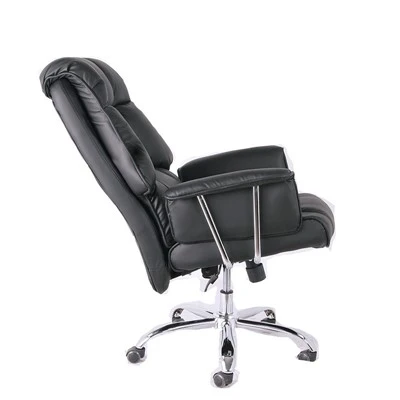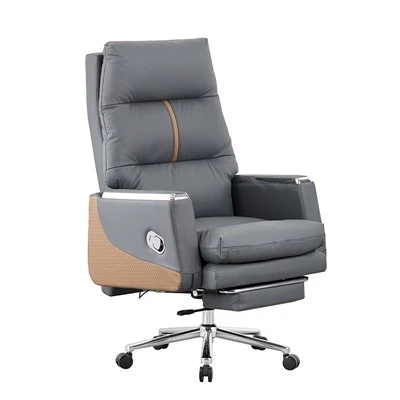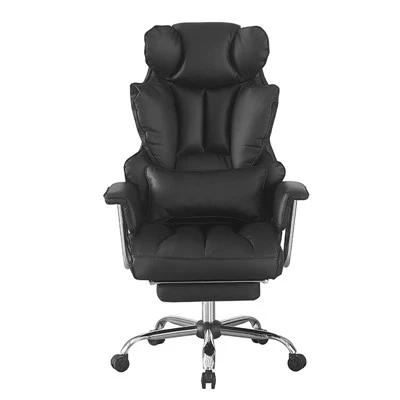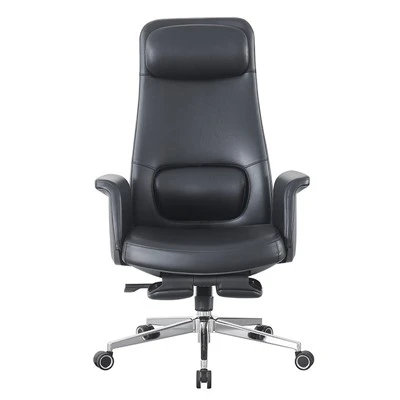


How to Choose an Ergonomic Chair: The Complete 2026 Buying Guide for People Who Sit 8+ Hours
By the Handsome Furniture Product & Ergonomics Team · Reviewed October 2026 · Last updated November 2026 · 9 min read
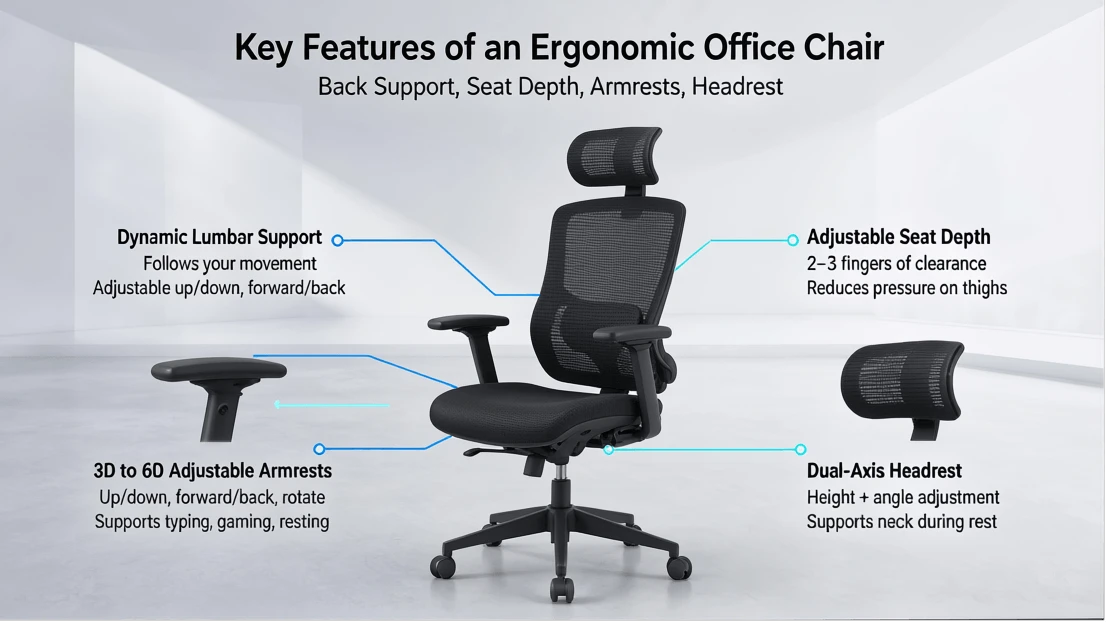
Quick answer: The right ergonomic chair does not ask you to adapt to it-it adjusts to your body and keeps your spine in its natural S-curve. Focus on four adjustable features that actually matter: lumbar support with height and depth adjustment, a sliding seat pan, 3D-or-better armrests, and a dual-axis headrest. Then verify the chair has been tested to a recognized standard such as EN 1335 (the European office-chair standard) or BIFMA X5.1. Everything else is secondary.
Eight hours in an ordinary chair has made back pain, soreness, and stiff shoulders a routine part of office life. A straight backrest and a decorative "lumbar pad" leave the lower spine unsupported and the pelvis tilted backward before lunch. Over time, that is not just a comfort problem-it is a productivity problem, and for buyers sourcing chairs for a whole team, a costly one.
This guide is written from the factory floor. Since 2009, we at Handsome Furniture have built and exported office chairs to more than 100 countries, and we have seen which specifications hold up after three years of real use-and which look good only in a catalogue. Here is what to look for, what to ignore, and how to verify a supplier's claims.
Why the Right Chair Is a Health Investment, Not a Furniture Purchase
When you sit, your spine should keep its natural S-curve: a gentle inward curve at the lower back, an outward curve through the mid-back, and a slight inward curve at the neck. A poorly designed chair flattens the lower curve, shifts weight onto the lumbar discs, and lets the shoulders roll forward. The result is the familiar ache after a long afternoon.
A genuinely ergonomic chair supports dynamic sitting-small, frequent changes of posture that keep blood flowing and muscles from locking up. That is why adjustability, not padding, is the single best predictor of long-term comfort. A very soft seat feels wonderful for ten minutes and fails after two hours.
The Five Core Principles of a Good Ergonomic Chair
1. Lumbar support: it must "follow" your lower back, not stay fixed
A cheap lumbar support is a rigid bump that stops fitting the moment you lean forward, recline, or turn to reach something. A good one adjusts up and down (to match your waist height) and in and out (to match the depth of your spinal curve), and on better models it moves with you as you shift position.
What to check: Press your lower back into the backrest. The support should touch the curve just above your beltline-not dig into your ribs or sit too low near the hips. If it cannot be moved, it fits one body type at best.
2. Seat height and seat depth: the two dimensions that decide everything
Seat height comes first. Your feet should rest flat on the floor with your knees at roughly 90 degrees and your thighs parallel to the ground. Look for a gas lift with a wide range; shorter users should check that the minimum seat height is 43 cm or less.
Seat depth is the most overlooked specification. If the seat is too deep, its front edge presses into the back of your knees and restricts circulation, causing numbness. If it is too shallow, you slide forward and lose back support. The ideal is a sliding seat pan with about 5 cm of travel, leaving a gap of two to three fingers between the edge of the seat and the back of your knees.
3. Armrests: 3D adjustment is the minimum, 4D or 6D is better
Armrests carry the weight of your arms. If they are too high, your shoulders shrug; too low, and you slump sideways to reach them. At minimum they should move up, down, forward, and backward; 3D adds side-to-side movement, and 4D adds tilt. Some premium designs offer 6D linkage that follows your recline automatically.
Why it matters at a desk: Adjustable armrests let you sit closer and keep elbows near a 90-degree angle while typing, gaming, or taking calls. If the armrests block you from pulling up to the desk, they are badly designed-lower them or choose a model whose arms can be removed.
4. Recline and tilt tension: for people who actually move
Static sitting is the enemy. A chair should let you lean back between tasks and lock upright when you need to focus. The key detail most buyers miss is tilt tension control-a knob that matches the recline resistance to your body weight. Without it, the chair either springs you back or refuses to move at all.
A useful range is roughly 110°–130° of recline, which reduces pressure on the lumbar discs. If you spend long stretches on calls or reading, this feature matters more than a premium upholstery upgrade.
5. Headrest: dual-axis adjustment is the baseline
A headrest that only slides up and down cannot support the back of your head and may encourage forward-head posture. Look for one that adjusts vertically and in angle (forward/back), so it cradles the neck when you recline during a midday break. If you sit upright and never recline, this is the one feature you can reasonably deprioritize.
Materials and Build: What Actually Survives Eight Hours a Day
| Component | What to look for | Why it matters |
|---|---|---|
| Backrest | High-resilience mesh, or contoured foam with zoned support | Mesh breathes in warm rooms; foam feels softer but holds more heat |
| Seat | High-density, high-resilience foam that does not "bottom out" | Low-grade foam flattens within months and loses support |
| Frame | Reinforced structure with heavy-duty stitching; one-piece nylon or aluminium | Determines load capacity and long-term stability |
| Base | Five-star base (the standard for stability) | Fewer spokes tip more easily |
| Castors | Hard wheels for carpet; soft/rubber wheels for wood or tile | Prevents floor scratches and improves rolling resistance |
| Upholstery | Water-resistant, scratch-resistant leather for leather models | Cuts replacement and after-sales costs |
A chair rated for a clearly published maximum load, with a gas lift and base backed by a warranty of at least three years, is signalling that the maker expects it to last. Vague or missing weight ratings are a red flag.
How to Read Chair Certifications (and Why They Matter)
"Ergonomic" has no legal definition on most markets-it appears on chairs with zero adjustment features. Certifications are the objective way separate a real ergonomic chair from a marketing claim.
- EN 1335 - the European standard for office chairs, covering dimensions (part 1), safety, strength and durability (part 2). Look for the current version, UNE-EN 1335-1:2021+A1:2023 / -2:2019.
- EN 12520 - strength, durability and safety for domestic seating.
- EN 16139 - strength and durability for non-domestic / contract seating, relevant for offices, hotels and public spaces.
- CE marking / GPSR (EU) 2023/988 - the EU General Product Safety Regulation; newer certificates reference it directly.
- BIFMA X5.1 - the widely used North American standard for general-purpose office chairs.
As a manufacturer, When you evaluate a supplier, ask for the certificate number and the model it covers, not just a logo on a webpage. A credential you cannot trace is not a credential.
Three Common Mistakes When Choosing an Ergonomic Chair
Mistake 1: Assuming more features always means a better chair.
Stacking adjustment levers does not equal practicality. If the lumbar support cannot be positioned precisely against the lumbar spine, no amount of armrest tilt will fix your lower back. Get the three core supports-lumbar, backrest and seat-right first, then pay for extras.
Mistake 2: Buying on specifications without sitting in the chair.
Bodies differ more than spec sheets suggest. Shorter users should confirm the minimum seat height (≤43 cm); heavier users should check the seat's resistance to sagging under load. Sit in the chair for at least 15 minutes and simulate real actions-leaning forward to type, reclining to take a call, turning to reach a folder. If you are buying online, ask the supplier for a sample first.
Mistake 3: Ignoring warranty and after-sales service.
Core components-the gas lift and base-should carry a warranty of at least three years. Confirm the return and exchange policy before ordering, so you are not left with a chair you cannot send back. For project purchases, also confirm who handles installation guidance and replacement parts.
Buying for a Team, a Project, or Resale? Read This Part
Everything above applies to one chair. Buying chairs for an office, a hotel, or a distribution catalogue adds three questions:
- Can the supplier fit different body types? A fixed-seat chair cannot serve a team of eight people with different heights. Adjustable ranges matter more per-unit cost.
- Can they customise? At Handsome we started as an OEM factory and now support full ODM customisation-colour, structure, logo and dedicated product development-with trial orders, mid-size purchases and bulk orders all accepted.
- Can they deliver and certify consistently? With modular workshops for frames, sewing, foam filling, assembly and QC, a daily capacity of 1,500–3,000 chairs, and full-process inspection (stability, load, abrasion and safety testing before shipment), we provide one-stop export service from sample confirmation and production tracking to inspection and customs clearance. Our products have reached over 100 countries and 500+ clients since 2009.
If you are sourcing ergonomic chairs for B2B, request the model-specific specification sheet, the certificate number, the MOQ and the lead time-in writing-before you compare prices.
Frequently Asked Questions
What features should a good ergonomic chair have?
Four are essential: height- and depth-adjustable lumbar support, a sliding seat pan, armrests that adjust at least up/down and forward/back (3D preferred), and a headrest with height and angle adjustment. Tilt tension control and a five-star base are strong signs of quality.
How do I know if a chair fits my body?
Sit with your back against the backrest. Your feet should be flat, knees near 90 degrees, and there should be two to three finger-widths between the seat edge and the back of your knees. Your lower back should be supported without pressure, and your elbows should rest near 90 degrees with shoulders relaxed.
Is a headrest necessary?
Only if you recline regularly. For upright desk work a headrest is largely decorative; for calls, reading and midday breaks, a dual-axis headrest supports the neck and helps prevent forward-head posture.
Are 4D or 6D armrests worth paying extra for?
They are worth it if several people share the chair, or if you switch between typing, gaming and resting. More axes let the chair fit more body types and desk setups. If one person uses one chair for typing only, 3D is sufficient.
What does EN 1335 certification mean?
EN 1335 is the European standard for office chairs. Part 1 sets dimensional requirements (including seat-height ranges for different body types); part 2 covers safety, strength and durability. A chair certified to the current version has passed independent dimensional and structural testing.
How long should a quality ergonomic chair last?
With high-resilience foam, a reinforced frame and a tested gas lift, three to five years of daily use is a reasonable expectation-which is why a warranty of at least three years on core components matters.
Can I order ergonomic chairs with my own logo or specifications?
Yes. OEM and ODM programmes typically cover colour, structure, logo and dedicated development. Ask the factory about trial-order quantities, sample lead time and certification for the customised model.
The Bottom Line
Choosing an ergonomic chair comes down to fit, adjustability and verifiable quality-not the number of levers or the word "ergonomic" in the product title. Prioritise lumbar support, seat height and depth, armrests and recline; confirm the standards and warranty; and buy from a manufacturer who will put the details in writing.
Handsome Furniture is a chair manufacturer based in Bazhou, Hebei, China. Since 2009 we have produced office chairs, ergonomic mesh chairs, gaming chairs and more for clients in over 100 countries, Need a quote or a sample? Contact our team or email angus03@bzangus.com.